

Table of Contents
- Why UPF Clothing Beats Sunscreen for Long Days Outside
- How UPF Clothing Actually Blocks UV Radiation
- UPF Clothing vs Regular Cotton Shirts: What the Rating Means
- How to Choose UPF Clothing That Fits Your Adventure
- UPF Clothing for Sensitive Skin and Chemical Reactions
- Cost Over Time: Sunscreen vs UPF Apparel
- Washing and Caring for UPF Clothing So It Lasts
- Conclusion: Stay Outside Longer With UPF Gear
- Frequently Asked Questions
Last Updated: September 27, 2026
Why UPF Clothing Beats Sunscreen for Long Days Outside
Sunscreen fails the moment you forget it, the honest reason why wear upf clothing instead of sunscreen is a question more outdoor families ask every year. At Dusty Gear Co, anglers, hikers, and off-roaders tell us the same thing: they lather up at 7 a.m., then burn by afternoon because nobody reapplied at noon.
UPF clothing solves that by putting protection on your body instead of your skin, put it on once and it works all day. Below: the reapplication problem, how UV-blocking fabric works, how to pick pieces, and what it costs over a season.
The core issue: sunscreen is a habit, and habits break. Clothing isn't a habit, it's just what you're wearing.
The Problem With Sunscreen Reapplication Frequency
Sunscreen reapplication frequency is the weak link in every sun safety plan. Most labels say every two hours, sooner after swimming, sweating, or toweling off.
That guidance exists for good reason: UV filters break down, wash away, and rub off on gear, so a single morning application leaves you exposed for hours.
A real outdoor day looks like this:
- You apply before the trailhead, then hike for three hours
- You sweat through your shirt and wipe your face
- You eat lunch, wash your hands, and forget your ears and neck
- You get back on the water for the hottest part of the day
Every one of those moments strips protection. Clothing skips the cycle: a long-sleeve UPF shirt covers your arms, shoulders, and back from the moment you pull it on until you take it off.

How UPF Clothing Actually Blocks UV Radiation
Ultraviolet Protection Factor (UPF) measures how much UV radiation a fabric blocks before it reaches your skin. UPF 50 means roughly 1/50th of UV passes through.
Fabric does this in three ways:
- Density: Tightly woven or knit fabric leaves less open space for UV rays to pass through
- Fiber type: Synthetic fibers like polyester and nylon tend to block more UV than loose natural fibers
- Color and treatment: Darker dyes absorb more UV, and some fabrics are engineered with UV-blocking additives
That's why a purpose-built sun shirt outperforms a random t-shirt: the fabric was designed for the job, not adapted to it.
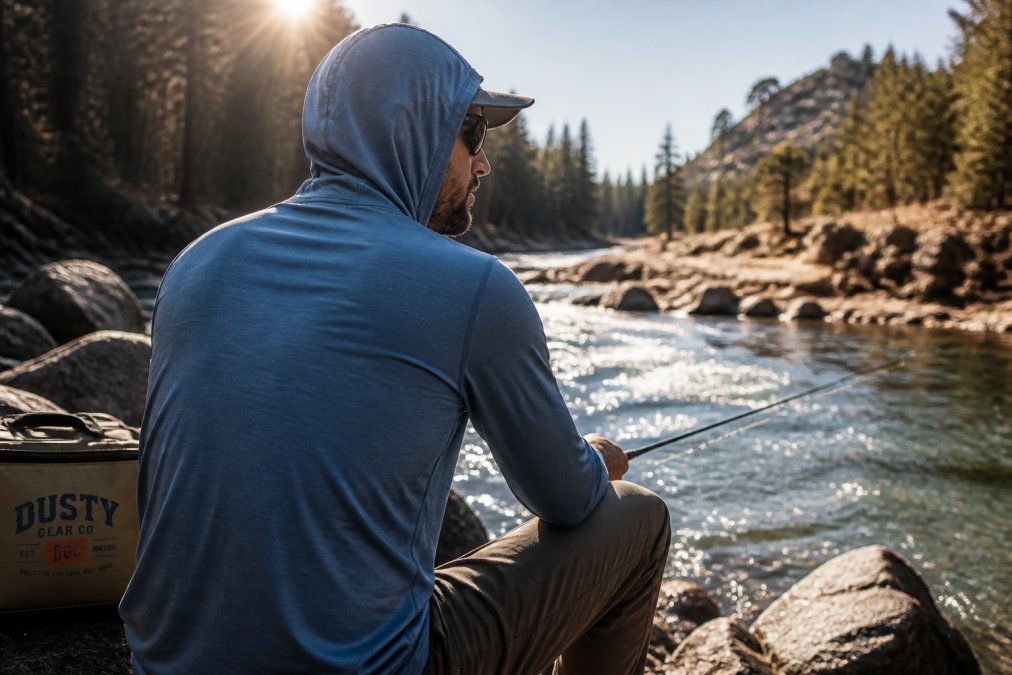
UPF Clothing vs Regular Cotton Shirts: What the Rating Means
Most regular cotton shirts carry no UPF rating. A white cotton tee blocks a modest amount of UV when new, but that drops as the fabric stretches, thins, and gets wet.
Wet fabric is the big one: a sweat- or river-soaked cotton shirt clings to your skin and lets far more UV through than the same shirt dry, a real problem when you're fishing in the heat.
UPF-rated apparel is tested as fabric, not guessed at. The FTC guidance on [sun protection(/blogs/news/best-durable-fishing-shirts-sun-protection) claims | ftc.gov] requires companies to back up protection claims, so a UPF 30 or UPF 50 label means something measurable.
Here's how the ratings compare in practice:
| Rating | Approximate UV Blocked | Best For |
|---|---|---|
| No rating (plain cotton tee) | Varies, drops when wet or stretched | Short errands, low UV days |
| UPF 15-24 | Good | Casual wear, brief exposure |
| UPF 25-39 | Very good | Hiking, fishing, yard work |
| UPF 40-50+ | Excellent | Full days outside, high UV index |
For a long day outdoors, the rated shirt wins every time.
How to Choose UPF Clothing That Fits Your Adventure
Choosing UPF clothing comes down to four things: rating, coverage, fabric, and fit. Get them right and the garment works for whatever you're doing outside; get them wrong and you've bought a shirt you won't wear.
Start with the rating, but read the fine print. UPF 50 blocks roughly 98% of UV radiation; UPF 30 blocks about 96.7%. That extra 1.3% matters on a high-UV-index day with hours of exposure, especially for fair-skinned people and anyone on photosensitizing medications. Look for the rating on the hangtag, not just the marketing copy.
Coverage beats rating. A UPF 50 short-sleeve shirt leaves forearms, neck, and ears exposed; a UPF 30 long-sleeve hooded shirt covers all of it.
-
Long sleeves over short
-
A hood or collar that covers the back of the neck
-
A longer hem that stays tucked when you bend or cast
-
Thumbholes or extended cuffs if you're on the water or holding handlebars
-
Hiking and off-roading: Look for lightweight, breathable knits with moisture-wicking treatment. You want air movement and quick dry time, because sweat-soaked fabric clings and feels hotter. A four-way stretch weave handles scrambling and climbing without binding.
-
Fishing and paddling: A hooded long sleeve with a higher collar keeps sun off your neck during long hours facing the water, where reflected UV roughly doubles your exposure. Quick-dry microfiber beats cotton every time here, cotton stays wet, gets heavy, and loses UV-blocking ability when soaked.
-
Gardening and yard work: You want durability over ultralight weight. A slightly heavier knit resists snags from branches and tools, and a looser cut lets you bend and reach without stretching the fabric thin across your back.
-
Commuting and casual wear: A UPF 30 to 50 button-down or polo in a darker color works for the drive, the walk from the car, and lunch outside. Darker dyes absorb more UV than light ones, so a navy or olive shirt outperforms a white one at the same rating.
-
Kids and family days: Lighter weights and looser cuts keep kids from overheating and complaining. Look for flat seams and tagless labels, scratchy gear comes off fast.
UPF Clothing for Sensitive Skin and Chemical Reactions
Sunscreen doesn't agree with everyone. Chemical filters can sting, trigger rashes, and irritate eczema-prone skin, and some people react to fragrances and preservatives in lotions.
Cost Over Time: Sunscreen vs UPF Apparel
A bottle of sunscreen is cheap up front. The math changes over a season of long days outside.
| Factor | Sunscreen | UPF Clothing |
|---|---|---|
| Up-front cost | Low per bottle | One-time purchase |
| Repeat purchases | Every few weeks | None |
| Reapplication needed | Every 2 hours | Never |
| Works when wet | No | Yes |
| Skin reactions | Possible | Unlikely |
Washing and Caring for UPF Clothing So It Lasts
UPF protection lives in the fabric itself, weave density, fiber type, and UV-blocking additives in the yarn. Good news: it doesn't wash off like sunscreen. Bad news: it degrades over time if you treat the garment like an old cotton tee.
The care routine that preserves the rating:
- Wash in cold or warm water on a normal cycle. Hot water accelerates fiber breakdown.
- Skip bleach and fabric softener. Bleach attacks the fibers; softener coats them and can reduce wicking performance.
- Use a mild detergent. Enzyme-heavy or heavily perfumed detergents are harder on technical fabrics.
- Tumble dry low or hang to dry. High heat is the single biggest killer of UPF performance.
- Avoid ironing directly on the fabric. If you must press it, use a low setting with a cloth barrier.
- Don't dry clean unless the label says it's safe. Solvents can degrade treatments.
Conclusion: Stay Outside Longer With UPF Gear
The hardest part of sun protection has never been knowing you need it, it's keeping up for eight hours straight. Sunscreen asks you to remember, reapply, and start over every two hours. UPF clothing asks you to get dressed.
Shop Dusty and stay outside longer.
Frequently Asked Questions
Do you still need sunscreen with UPF clothing?
UPF clothing covers the skin it touches, but exposed areas like your face, neck, ears, and hands still need protection. A UPF 50+ shirt blocks most UV radiation on your torso and arms, yet dermatologists recommend pairing it with broad-spectrum sunscreen on uncovered skin. Think of UPF apparel as your base layer of photoprotection and sunscreen as the backup for gaps. Together they reduce sunburn risk and long-term skin damage more effectively than either one alone.
Does UPF clothing actually work, and how does it compare to regular cotton shirts?
Yes, UPF clothing works because the fabric is tested and rated for ultraviolet protection factor. A white cotton t-shirt typically offers only UPF 5 to UPF 10, letting significant UV radiation through, especially when wet or stretched. Dedicated UPF clothing uses tighter fabric weave, synthetic fibers, and sometimes UV-blocking treatments to reach UPF 30 or UPF 50+. That difference matters during long hikes, fishing trips, or off-road days when you cannot reapply sunscreen every two hours.
How long does UPF 50+ clothing last, and does washing degrade the rating?
Most UPF 50+ garments keep their rating for years if you care for them properly. The protection comes from the fabric structure and dyes, not just a surface coating, so normal washing does not strip it. Avoid bleach, fabric softener, and high-heat drying, which can break down fibers over time. Wash in cold water and hang dry when possible. If the fabric becomes stretched, faded, or worn thin, the UV-blocking ability drops and it is time to replace the garment.
Is UPF clothing better than sunscreen for sensitive skin?
For many people with chemical sensitivities or skin reactions, UPF clothing is the better choice. Sunscreen relies on chemical filters or physical blockers that can irritate skin, clog pores, or trigger allergic responses. UPF apparel provides a physical barrier without any product touching your skin, so there is no risk of stinging eyes, breakouts, or reactions. It also eliminates the reapplication cycle that exposes sensitive skin to repeated product contact throughout the day. Pair it with a mineral sunscreen on your face if needed.